Ground reaction forces are the forces that are exerted between the body and the ground during ambulation (see fig 1). The ground produces reaction forces in three planes; Two are shearing forces that are parallel to the ground and the third is an impact force that is perpendicular to the ground.

Awareness of ground reaction forces is important in the examination of gait and musculoskeletal injury as some of the greatest forces applied to the foot occur during acceleration. This can be crucial information when treating a patient who is a runner or participates in any activity in which ground reaction forces affect performance (e.g a pitcher in baseball with a first metatarsophalangeal pain will have difficulty at ball realease since ground reaction forces applied to the painful joint of the great toe will significantly affect the pither’s follow through).
Vertical forces applied during stance depend on several factors such as the body’s weight, stride length, cadence, impact style, footwear and ground surface. The amount of vertical force varies through the gait cycle and is greatest during push off as acceleration for forward movement occurs and is minimal when the body weight is shared during the double-limb support phase.
Ground forces affect gait as a whole (since the joints work simultaeneously and rapidly in order to produce prposeful movement). Shear forces occur in a fore-aft direction and in a lateral-medial direction (see fig 2.). At initial contact, the fore-aft shear force is a forward force. As the foot moves into swing, it is a backward force. Shortening stride length reduces fore-aft shear forces but increases vertical forces. Additionally, with a shortened stride, there is a larger foot surface in contact at both the start and the end of stance, so forces are distributed over a larger area.
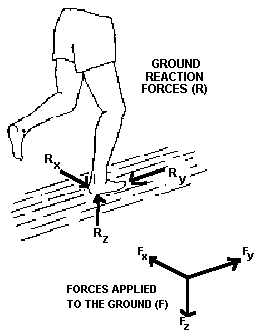
Fore-aft (or anteroposterior forces) are associated with both acceleration and deceleration forces while the medial lateral shear force is associated with the foot during initial contact (the foot typically hits the ground on the lateral heel and the ground forces move from lateral to medial as the entire foot contacts the ground).
Ref; Houglum P A. Therapeutic Exercise for Musculoskeletal Injuries. 2016. 4th Edition. Human Kinetics Publishers. Chapter 11. Ambulation and Ambulation Aids. Ground Reaction Forces. Pgs 324 – 325.
1
0